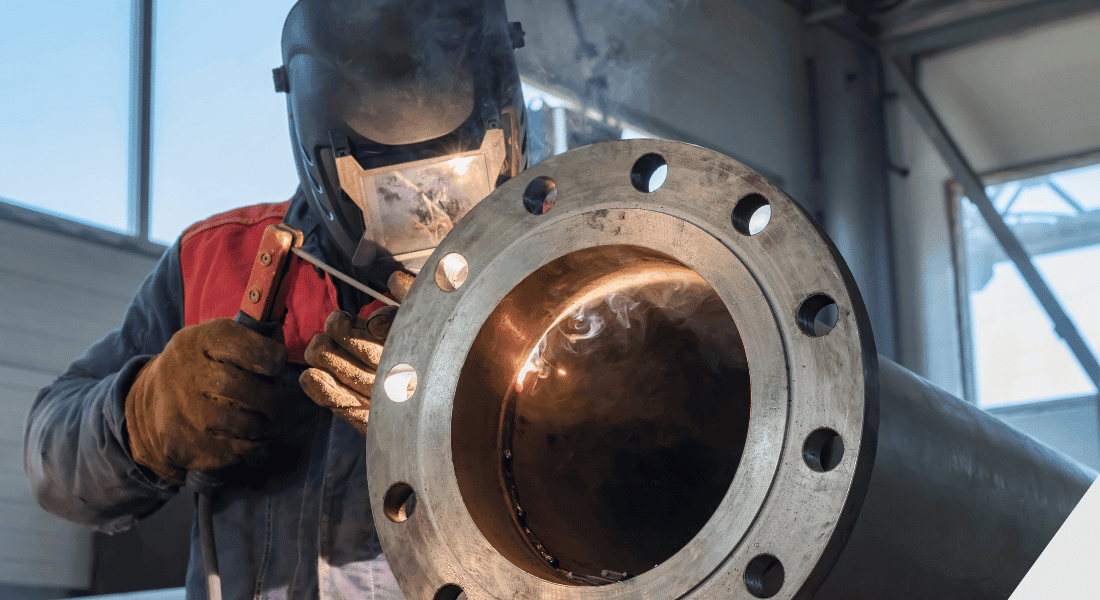
Part 3 of Western Forge & Flange’s Metal Alloy Series
In Part 1, we covered Hastelloy® C276 and C22 for severe chemical attack. In Part 2, we moved into high-nickel alloys built for extreme temperature and mechanical stress. This installment covers the space in between — where standard 304 or 316 stainless is failing, but a full jump to a nickel alloy would mean paying a premium your application doesn’t actually need.
For refining engineers managing thermal cycling, power generation plants, and piping buyers looking for a targeted upgrade, that middle ground is where 304H, 317/317L, 321, and 347H live — and Western Forge & Flange stocks all four, ready to ship as standard flanges or custom forgings.
Why Standard Stainless Steel Fails at High Temperature
Standard 304 and 316 stainless steel perform well at room temperature. But push them into sustained service between 800°F and 1500°F, and a specific failure mode takes over: carbide precipitation.
Here’s what actually happens. At that temperature range, carbon inside the steel migrates to the grain boundaries and bonds with chromium, forming chromium carbides. That reaction strips the surrounding metal of the very chromium layer that protects it from corrosion. The grain boundaries are left exposed and vulnerable — and under thermal cycling, that vulnerability shows up as micro-fissures, weld decay, and premature intergranular cracking.
In plain terms: the steel isn’t melting or bending. It’s losing its corrosion defense from the inside out, and it fails quietly until it doesn’t.
The four grades below solve that problem in different ways — either by stabilizing the carbon before it can react, by adjusting the carbon content itself to work in the material’s favor, or by targeting a different failure mode (chloride pitting) entirely. All four are part of Western Forge & Flange’s in-stock inventory.
304H: Creep Strength for Sustained High-Temperature Service
Quick overview: A high-carbon variant of standard 304 stainless steel, purpose-built for continuous service at elevated temperatures rather than corrosion resistance alone.
Material properties: 304H holds carbon in the 0.04%–0.10% range instead of minimizing it. That sounds counterintuitive — carbon is usually the enemy in high-temp service — but at sustained elevated temperatures, that carbon window measurably improves creep strength and stress-rupture resistance, which is what actually matters for components that spend years running hot without shutting down.
Weldability: 304H welds like standard 304 austenitic stainless using common filler metals (ER308/308L) and standard GTAW/GMAW practice — no exotic procedures required. Because it isn’t stabilized with titanium or columbium, heat-affected zones held for extended periods in the 800°F–1500°F range can still be prone to sensitization, so critical welded assemblies destined for long-term high-heat service are typically solution annealed after fabrication.
Corrosive properties: Corrosion resistance is comparable to standard 304 stainless at room and moderate temperatures. Its advantage isn’t chemical resistance — it’s structural stability under sustained heat, which indirectly protects against the cracking that leads to leak paths.
Industry/process usage: Refining boilers, heat exchangers, and power generation components running continuously up to 1500°F.
In stock: Western Forge & Flange stocks 304H flanges and forging stock, ready for standard weld neck, blind, slip-on, and socket weld configurations.
317 / 317L: Molybdenum Upgrade for Pitting Resistance
Quick overview: Not a heat solution — 317 and 317L target localized pitting and crevice corrosion in chloride-rich or acidic environments.
Material properties: 317L carries 3%–4% molybdenum, compared to 2%–3% in standard 316L. That difference sounds small on paper, but it meaningfully raises the alloy’s Pitting Resistance Equivalent Number (PREN) — the metric that predicts how well a stainless grade resists localized pitting and crevice corrosion.
Weldability: The “L” designation means low carbon (≤0.03%), which minimizes carbide precipitation in the heat-affected zone during welding. That makes 317L notably easier to weld without post-weld heat treatment, and it preserves corrosion resistance right up to the weld line — a real advantage for field-welded piping systems.
Corrosive properties: This is where 317L earns its place. In flue gas desulfurization systems, pulp and paper bleach lines, and other chloride-heavy or acidic process streams, its improved PREN is the difference between a flange that lasts and one that develops pinhole leaks years ahead of schedule.
Industry/process usage: Flue gas desulfurization, pulp and paper bleach lines, and other moderately hot, chemically aggressive process streams that don’t require a full nickel-alloy upgrade.
In stock: Western Forge & Flange stocks 317/317L flanges and custom forging blanks, with in-house metallurgical guidance on when 317L solves the problem versus when it doesn’t.
321 / 321H: Titanium-Stabilized for the Carbide Precipitation Range
Quick overview: A titanium-stabilized grade engineered specifically to survive prolonged exposure across the 800°F–1500°F carbide precipitation window without losing corrosion resistance at the grain boundaries.
Material properties: Titanium is added at a minimum of five times the material’s carbon content. The titanium bonds with carbon before it can migrate to the grain boundaries and strip out chromium — the same failure mode that damages unstabilized 304 and 316 under sustained heat.
Weldability: This is where titanium stabilization pays off directly. It prevents intergranular corrosion (commonly called “weld decay”) in the heat-affected zone, making 321 a preferred choice for heavy-wall welded components that can’t be solution annealed after fabrication — a meaningful advantage on large, field-assembled equipment. One caveat: titanium can reoxidize during multi-pass or shielded welding, so filler metal and shielding gas selection matter more than with columbium-stabilized grades like 347H.
Corrosive properties: Resistant to intergranular attack across the full carbide precipitation range, with general corrosion resistance similar to standard 304/321 stainless outside that temperature window.
Industry/process usage: Heavy exhaust systems and chemical reactors that spend extended periods cycling through the 800°F–1500°F range, where an unstabilized grade would be living on borrowed time.
In stock: Western Forge & Flange stocks 321/321H flanges and forgings, including custom rings and discs for non-standard geometries.
347H: Columbium-Stabilized for High-Stress Steam and Refining Service
Quick overview: Combines 304H’s high-carbon creep strength with columbium (niobium) stabilization — solving for sustained heat and carbide precipitation at the same time.
Material properties: 347H carries the same elevated carbon content as 304H, but the added columbium binds with carbon preferentially, before it can migrate to the grain boundaries and attack the surrounding chromium. That combination is why 347H commands a premium over 304H in the highest-stress steam and refining applications.
Weldability: Columbium stabilization serves the same anti-weld-decay function as titanium in 321, but without titanium’s tendency to reoxidize during welding. That makes 347H a common preference over 321 for shielded, multi-pass welds on heavy sections — high-pressure steam piping being the classic example — where weld integrity over long seams is critical.
Corrosive properties: Resistant to intergranular corrosion across the carbide precipitation range, combined with the creep and stress-rupture resistance of the high-carbon 304H chemistry — a rare pairing of both failure modes solved in one grade.
Industry/process usage: High-pressure steam lines and refinery cracking units, where both sustained heat and long-term structural stiffness are non-negotiable.
In stock: Western Forge & Flange stocks 347H flanges and forging stock, including custom blocks and rings for cracking-unit and steam-line applications.
Quick Reference: Matching the Grade to the Failure Mode
| Grade | Stabilizing Mechanism | Weldability Note | Max Operational Threshold | Primary Failure Prevented | Best For |
| 304H | High-carbon chemistry (0.04%–0.10%) | Standard austenitic welding; solution anneal recommended for long-term high-heat welded assemblies | 1500°F (816°C) | High-temp creep & thermal sagging | Refining boilers, heat exchangers, power plants |
| 317 / 317L | Elevated molybdenum (3.0%–4.0%) | Low-carbon “L” grade resists carbide precipitation at the weld line; no PWHT typically needed | 1000°F (538°C) | Chloride pitting & acetic acid corrosion | Flue gas desulfurization, pulp & paper |
| 321 / 321H | Titanium-stabilized | Prevents weld decay in heavy-wall, non-annealed assemblies; watch filler/shielding for titanium reoxidation | 800°F–1500°F | Intergranular corrosion & carbide precipitation | Heavy exhaust systems, chemical reactors |
| 347H | Columbium/niobium-stabilized | Prevents weld decay without titanium’s reoxidation risk; favored for multi-pass welds on heavy sections | 800°F–1500°F | High-stress creep & weld-zone degradation | High-pressure steam lines, refinery cracking units |
The Western Forge Difference: The Right-Sized Solution, Delivered Fast
You don’t always need to jump to a hyper-expensive nickel alloy to solve a high-temperature or pitting problem. That’s the gap Western Forge & Flange is built to close — the space between basic commercial stainless supply and premium niche forging, backed by the technical depth to know which grade actually fits your failure mode.
What we deliver:
- 304H, 317/317L, 321/321H, and 347H in stock now — no waiting on mill lead times for standard flanges or forging stock
- Standard weld neck, blind, slip-on, and socket weld flanges in all four grades
- Custom forged blocks, rings up to 75 inches in diameter, and discs up to 2,500 pounds
- 5-day emergency turnaround and extensive in-stock inventory across 80+ premium alloys — built for refinery shutdowns and outages that can’t wait 14 weeks
- Full material traceability and documentation backed by ISO 9001:2015 certification, with PED, PER, and nuclear-level compliance available on request
When standard stainless is failing and a nickel alloy feels like overkill, our Texas-based team helps you land on the grade that solves the actual problem — without over-engineering the budget or the weld procedure.
Frequently Asked Questions
Carbide precipitation happens when standard austenitic stainless steels like 304 or 316 sit between 800°F and 1500°F. Carbon migrates to the grain boundaries and bonds with chromium, stripping the surrounding metal of its corrosion protection. Under thermal cycling, this leads to micro-fissures and premature intergranular cracking. Stabilized grades like 321 and 347H prevent this by binding carbon with titanium or columbium before it can react with chromium.
No — if anything, their stabilization makes them more forgiving for welded fabrication. Titanium (321) and columbium (347H) bind carbon before welding heat can drive it to the grain boundaries, which prevents weld decay without requiring post-weld heat treatment. Standard shop welding practices apply; filler metal selection is the main variable to get right.
Specify 317L when your process fluid involves higher chloride concentrations, hot sulfurous gases, or aggressive organic acids that cause 316L to pit. 317L’s higher molybdenum content (3%–4% versus 2%–3% in 316L) significantly improves pitting resistance without the cost of moving to a nickel alloy, and its low carbon content keeps that resistance intact after welding.
The difference comes down to carbon content. Standard 347 keeps carbon low, while 347H maintains a strict 0.04%–0.10% carbon range. That elevated carbon meaningfully improves long-term creep strength and stress-rupture resistance at elevated temperatures, making 347H the preferred specification for high-pressure steam and refining service above 1000°F.
Western Forge & Flange stocks 304H, 317/317L, 321/321H, and 347H as both standard flanges and forging stock, alongside 80+ other alloys in inventory. Custom shapes — blocks, rings up to 75 inches in diameter, and discs up to 2,500 pounds — are forged to order with a 5-day emergency turnaround available.
Our Cleveland, Texas facility forges 304H, 317/317L, 321/321H, and 347H into standard flanges up to 2,500 pounds, plus custom shapes including blocks, rings up to 75 inches in diameter, and discs up to 2,500 pounds. Every run carries full ISO 9001:2015 documentation with material traceability.
That closes out our three-part Metal Alloy Series — from severe chemical resistance (Part 1), to high-temperature and high-stress nickel alloys (Part 2), to the advanced stainless grades that solve targeted problems without over-engineering your budget.
Need a fast-turnaround quote on 304H, 317L, 321, or 347H forgings? Contact Western Forge & Flange to talk specs, tolerances, and timelines.